
EMAIL SUPPORT
dclessons@dclessons.comLOCATION
USTCP Optimization
TCP optimization is supported in the Viptela operating system, Cisco WAAS, and AppQoE for IOS XE routers. All three platforms support TCP optimization, but there are differences in their implementations.
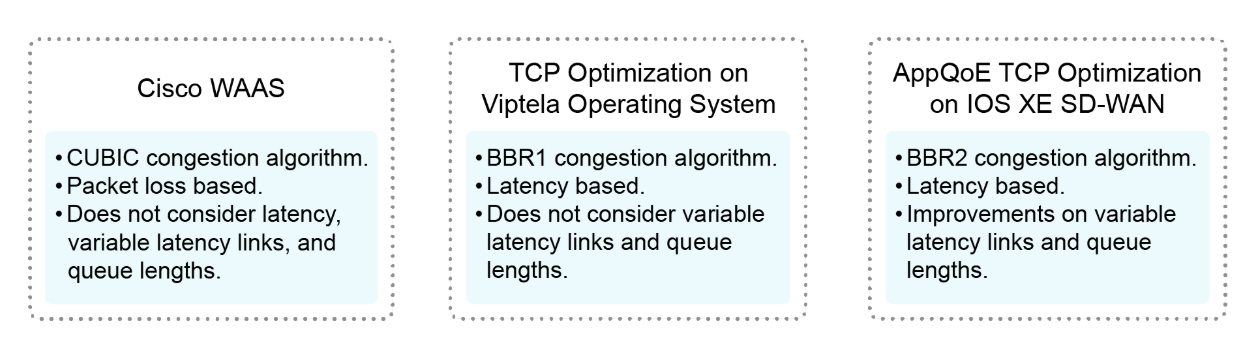
In addition to guaranteed packet delivery, TCP incorporates flow control, which determines the transmission speed based on link congestion. Cisco WAAS employs the CUBIC congestion algorithm developed by Google to calculate the sending rate. This algorithm suits traditional loss-based networks, where packet loss is crucial in determining the transmission rate.
However, Google introduced BBR as a new congestion control mechanism that uses latency instead of packet loss to determine the sending rate. BBR1 and BBR2 are two versions of BBR. The Viptela operating system uses BBR1, which outperforms CUBIC, providing improved throughput and reduced latency. Nevertheless, BBR1 has limitations in handling different link latencies and queue lengths.
AppQoE adopts BBR2, an enhanced version of BBR1, which considers variable latency links and queue lengths while reducing retransmissions. Recall that AppQoE also incorporates features such as FEC, packet duplication, and DRE or LZ, further enhancing the overall application experience for on-premises or cloud-based deployments.
TCP optimization improves the processing of TCP data traffic to reduce round-trip latency and increase throughput.
If you want to improve the performance of TCP traffic, optimizing it can be beneficial, especially for long-distance connections like those found on transcontinental links and very-small-aperture terminal (VSAT) satellite communication systems. Additionally, optimizing TCP traffic can enhance the performance of SaaS applications.
TCP optimization involves a router serving as a TCP proxy between a client starting a TCP flow and a server waiting for the flow.
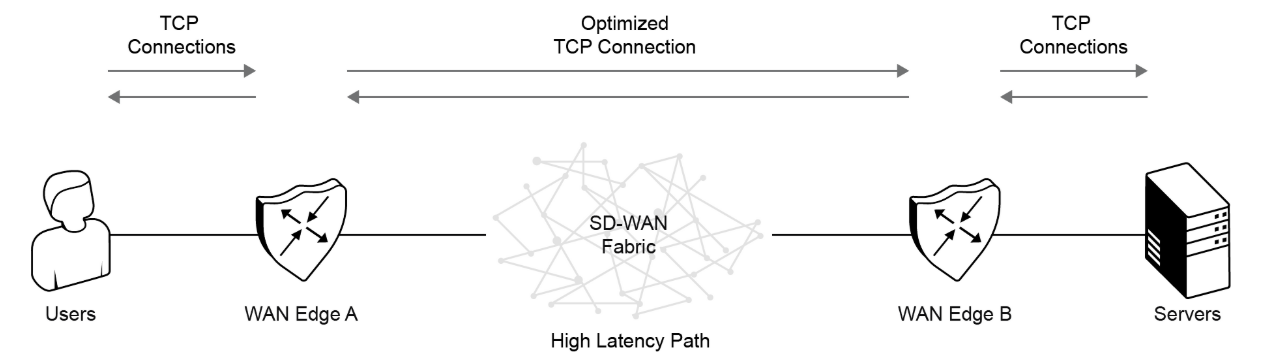
In the figure, two routers act as proxies: WAN Edge A as the client proxy and WAN Edge B as the server proxy. With TCP optimization on, WAN Edge A terminates the client's TCP connection and establishes a new one with WAN Edge B, which then connects to the server. Buffer caching is used to maintain TCP traffic and prevent timeouts.
The general recommendation is to configure TCP optimization on client-proximal and server-proximal routers. This configuration, known as a dual-ended proxy, helps to ensure optimal performance. Although it is possible to configure TCP optimization only on the client-proximal router, referred to as a single-ended proxy, Cisco does not recommend this approach because it compromises the TCP optimization process. TCP is a bidirectional protocol, so it relies on a timely acknowledgment of connection-initiation synchronization (SYN) messages through acknowledgment (ACK) messages for proper operation.
To use TCP optimization, first enable the feature on the router, then define which TCP traffic to optimize.
Topology and Roles
To implement TCP optimization, the concept of service node and controller is used. The service node is a daemon that runs on the WAN Edge device, and it is responsible for the actual optimization of TCP flows. The controller is known as the AppNav Controller and is responsible for traffic selection and transport to and from the service node. The service node and the controller can run on the same router or separate routers. AppNav is covered in more detail in a later topic.

Comment
TABLE OF CONTENTS
- Onboarding & Provisioning Configuring Templates
- Authentication between vSmart & vBond
- Authentication between vSmart Controller
- Authentication between vBond & vEdge Router
- Authentication between vEdge Router & vManage NMS
- Authentication between vSmart Controller & vEdge Router
- Viptela Specific Port Terminology
- Deploy & Configure vManage & Generate Certificate
- Deploy & Configure vBond & Generate Certificate
- Deploy & Configure vSmart & Generate Certificate
- Configure vEdge & Generate Certificate
- SDWAN & NAT
- Secure DataPlane Bringup
- Enterprise CA for SDWAN Instances
- ZTP Process & PnP Overview
- Control Plane & Data Plane Operation - Unicast Routing Overview
- Configuring OMP & Its attributes
- Configure Unicast Overlay Routing
- Routing Configuration Example
- Segmentation Overview
- Configuring Segmentation
- Segmentation Configuration Example
- Data Traffic across Private WANs
- NAT in SDWAN & Data Encryption
- SD-WAN Viptela Policy Overview
- SD-WAN Centralized & Localized Control Policy Overview
- SD-WAN Centralized & Localized Data Policy
- Service Chaining
- Traffic Flow Monitoring
- vEdge Router as NAT Device
- Zone Based Firewalls
- Configure Centralized Control Policy
- Configuring Centralized Data Policy
- Configuring Cflowd Traffic Monitoring
- Configuring Zone based Firewall
- Service Chaining Configuration Example
- Configuring Service Side NAT
- Configuring Transport side NAT
- Control Policy Example 1: Hierarchical Topology
- Multi-Region Fabric
- Control Policy Example 2: Implementing Traffic Engineering
- Control Policy Example 2: Dynamic On-Demand Tunnels
- LAB Deploy Cisco SD-WAN Edge Routers
- LAB Deploy SDWAN Controllers
- LAB Deploy Cisco SD-WAN Devices Using Configuration Group
- LAB Implement Service-Side Routing Protocols
- LAB Implement TLOC Extensions
- LAB Implement Control Policies
- LAB Implement Data Policies
- LAB Implement Application-Aware Routing
- LAB Implement Branch and Regional Internet Breakouts
- LAB Migrate Branch Sites
RECENT POSTS
- Understanding Cisco ISE Authentication and Authorization Policies
- Installing Context-Aware Network Access Control using Cisco ISE Policies
- Designing Network Access Control that is Scalable using Cisco ISE Architecture
- Enterprise Network Access Control and Policy Enforcement using Cisco ISE
- Secure Device Administration and Network Access Using AAA Architecture
- Designing Enterprise-Class Hybrid Cloud Connectivity Using AWS Networking Services
- Exploring Core AWS Networking and Messaging Concepts for Modern Cloud Architectures
- Understanding Key AWS Services for Modern Cloud Architectures
- Building a Strong AWS Foundation with Amazon S3, EC2, and Virtual Private Cloud
- Understanding the ENSDWI Course: Advanced Cisco SD-WAN (Viptela) Concepts


LEAVE A COMMENT
Please login here to comment.