
EMAIL SUPPORT
dclessons@dclessons.comLOCATION
USSDWAN & NAT
The NAT environment includes these features:
-
NAT allows hosts with private IP addresses in a LAN to communicate with devices in public address spaces, such as the internet.
-
Network devices configured with NAT can function as hardware firewalls to prevent unwanted data traffic from passing through a WAN Edge (and to LAN networks in the service side networks connected to the WAN Edge device).
-
To enhance the security at branch sites, you can place the WAN Edge router behind a NAT network device or firewall.
-
The WAN Edge router can interact with NAT devices configured with the following Session Traversal Utilities for NAT (STUN) methods.
-
Full-cone NAT
-
Address-Restricted Cone NAT
-
Port-Restricted Cone NAT
-
Symmetric-NAT
-
By default, all Cisco SD-WAN devices use base port 12346 for establishing the connections that handle control and data traffic in the overlay network. Each device uses this port when establishing connections with other Cisco SD-WAN devices.
Recall that when multiple Cisco SD-WAN devices are installed behind a single NAT device, you can configure different port numbers for each device. That way, the NAT can properly identify each individual device. You do this by configuring a port offset from the base port 12346. The default port offset is 0.
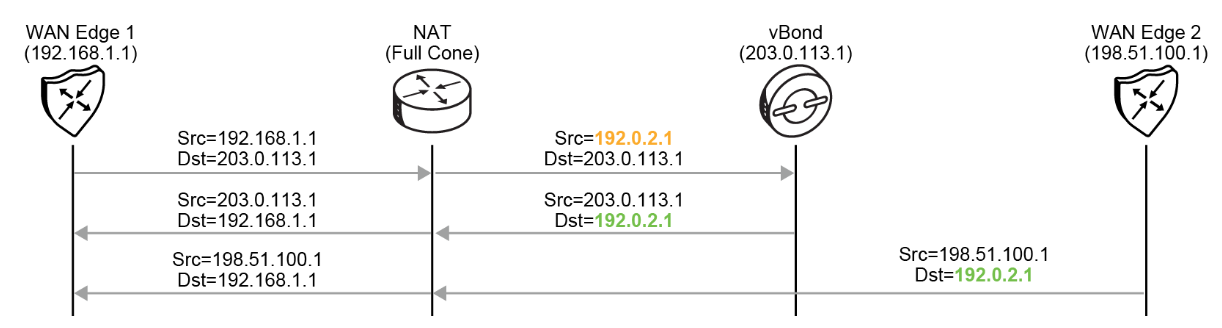
Full-Cone NAT
A full-cone is one where all packets from the same internal IP address are mapped to the same NAT IP address. This type of address translation is also known as One-to-One.
Additionally, external hosts can send packets to the internal host, by sending packets to the mapped NAT IP address.
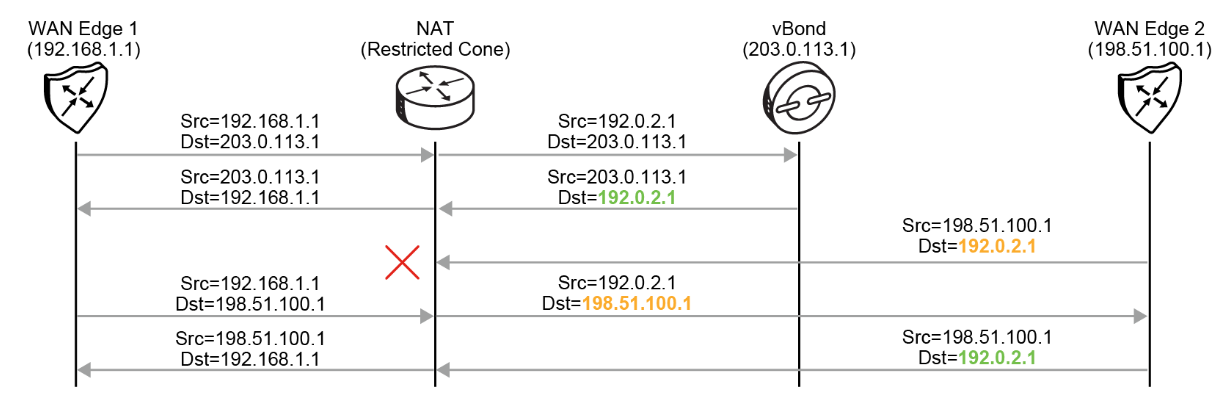
Restricted-Cone NAT
A Restricted-Cone network address translation is also known as Address-Restricted-Cone. It is a network translation technique where all packets from the same internal IP address are mapped to the same NAT IP address. The difference to a Full-Cone is that an external host can send packets to the internal host only if the internal host had previously sent a packet to the IP address of the external destination. It is important to note that once the NAT mapping state is created, the external destination can communicate back to the internal host on any port.
Port-Restricted-Cone NAT
A Port-Restricted-Cone is similar to the Restricted-Cone address translation, but the restriction includes also port numbers. The difference is that an external destination can send back packets to the internal host only if the internal host had previously sent a packet to this destination on this exact port number. In a typical Cisco IOS/IOS-XE or Cisco ASA configuration, this feature is known as Port Address Translation (PAT).

Comment
TABLE OF CONTENTS
- Onboarding & Provisioning Configuring Templates
- Authentication between vSmart & vBond
- Authentication between vSmart Controller
- Authentication between vBond & vEdge Router
- Authentication between vEdge Router & vManage NMS
- Authentication between vSmart Controller & vEdge Router
- Viptela Specific Port Terminology
- Deploy & Configure vManage & Generate Certificate
- Deploy & Configure vBond & Generate Certificate
- Deploy & Configure vSmart & Generate Certificate
- Configure vEdge & Generate Certificate
- SDWAN & NAT
- Secure DataPlane Bringup
- Enterprise CA for SDWAN Instances
- ZTP Process & PnP Overview
- Control Plane & Data Plane Operation - Unicast Routing Overview
- Configuring OMP & Its attributes
- Configure Unicast Overlay Routing
- Routing Configuration Example
- Segmentation Overview
- Configuring Segmentation
- Segmentation Configuration Example
- Data Traffic across Private WANs
- NAT in SDWAN & Data Encryption
- SD-WAN Viptela Policy Overview
- SD-WAN Centralized & Localized Control Policy Overview
- SD-WAN Centralized & Localized Data Policy
- Service Chaining
- Traffic Flow Monitoring
- vEdge Router as NAT Device
- Zone Based Firewalls
- Configure Centralized Control Policy
- Configuring Centralized Data Policy
- Configuring Cflowd Traffic Monitoring
- Configuring Zone based Firewall
- Service Chaining Configuration Example
- Configuring Service Side NAT
- Configuring Transport side NAT
- Control Policy Example 1: Hierarchical Topology
- Multi-Region Fabric
- Control Policy Example 2: Implementing Traffic Engineering
- Control Policy Example 2: Dynamic On-Demand Tunnels
- LAB Deploy Cisco SD-WAN Edge Routers
- LAB Deploy SDWAN Controllers
- LAB Deploy Cisco SD-WAN Devices Using Configuration Group
- LAB Implement Service-Side Routing Protocols
- LAB Implement TLOC Extensions
- LAB Implement Control Policies
- LAB Implement Data Policies
- LAB Implement Application-Aware Routing
- LAB Implement Branch and Regional Internet Breakouts
- LAB Migrate Branch Sites
RECENT POSTS
- Understanding Cisco ISE Authentication and Authorization Policies
- Installing Context-Aware Network Access Control using Cisco ISE Policies
- Designing Network Access Control that is Scalable using Cisco ISE Architecture
- Enterprise Network Access Control and Policy Enforcement using Cisco ISE
- Secure Device Administration and Network Access Using AAA Architecture
- Designing Enterprise-Class Hybrid Cloud Connectivity Using AWS Networking Services
- Exploring Core AWS Networking and Messaging Concepts for Modern Cloud Architectures
- Understanding Key AWS Services for Modern Cloud Architectures
- Building a Strong AWS Foundation with Amazon S3, EC2, and Virtual Private Cloud
- Understanding the ENSDWI Course: Advanced Cisco SD-WAN (Viptela) Concepts


LEAVE A COMMENT
Please login here to comment.