
EMAIL SUPPORT
dclessons@dclessons.comLOCATION
USLoop Prevention Mechanism
A routing loop is a serious network problem that occurs when a data packet is routed through the same routers repeatedly. The network continues to route data packets within the network in an endless circle. A routing loop can have a catastrophic impact on a network and, sometimes, can completely disable the network.
-
Routing loop-data packets are continually routed through the same router, over and over, which results in the following issues:
-
Bandwidth is consumed
-
Processing power is lost
-
-
Loop prevention mechanisms are available:
-
Down (DN) Bit in OSPF
-
Site of Origin (SoO) Community in BGP
-
Propagate AS in BGP
-
External Protocol field in EIGRP
-
If you have a routing loop in your network, a major portion of the limited bandwidth that is available for normal user traffic of the affected routers is consumed by looping IP datagram packets and the major portion of the processing power is used to process the looping IP datagram packets.
Route Redistribution—Default Behavior
OMP automatically redistributes the following types of routes that it learns either locally or from its routing peers:
-
Connected
-
Static
-
OSPF intra-area routes
-
OSPF interarea routes
All other routing protocols require explicit configuration to enable redistribution.
To avoid propagating excessive routing information from the edge to the access portion of the network, the routes that WAN Edge routers receive through OMP are not automatically redistributed into the other routing protocols running on the routers. If you want to redistribute the routes received through OMP, you must enable this redistribution locally on each WAN Edge router.
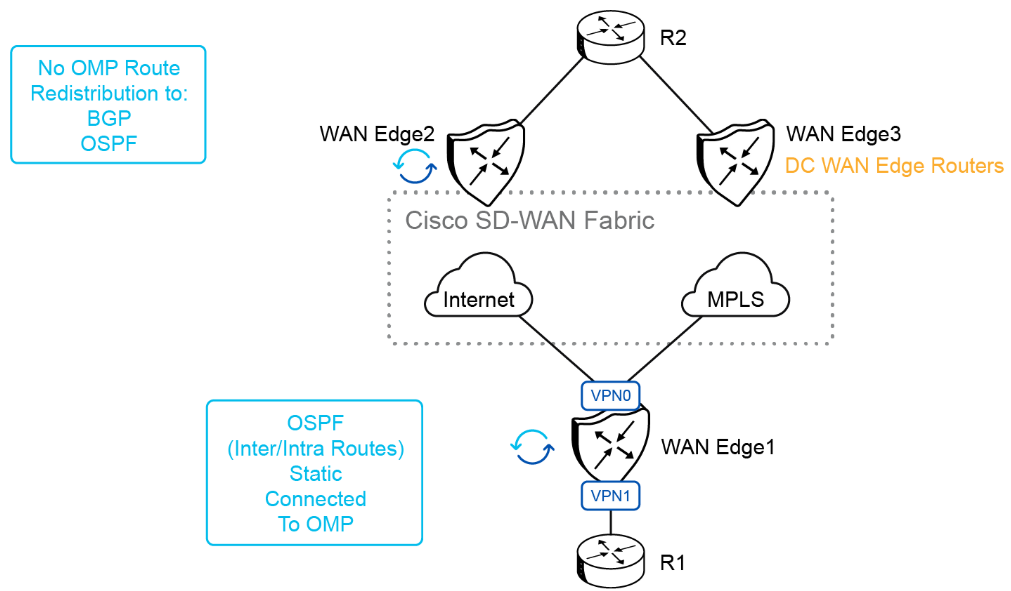
To avoid routing loops and less than optimal routing, redistribution of the following types of routes requires explicit configuration:
-
BGP
-
OSPF external routes
-
EIGRP
OSPF Route Redistribution
RFC 4577 has been implemented to solve the routing loop issue with OSPF. RFC 4577 implements a concept called the down bit (DN). OMP routes are redistributed into OSPF as External routes with the Down (DN) bit set.
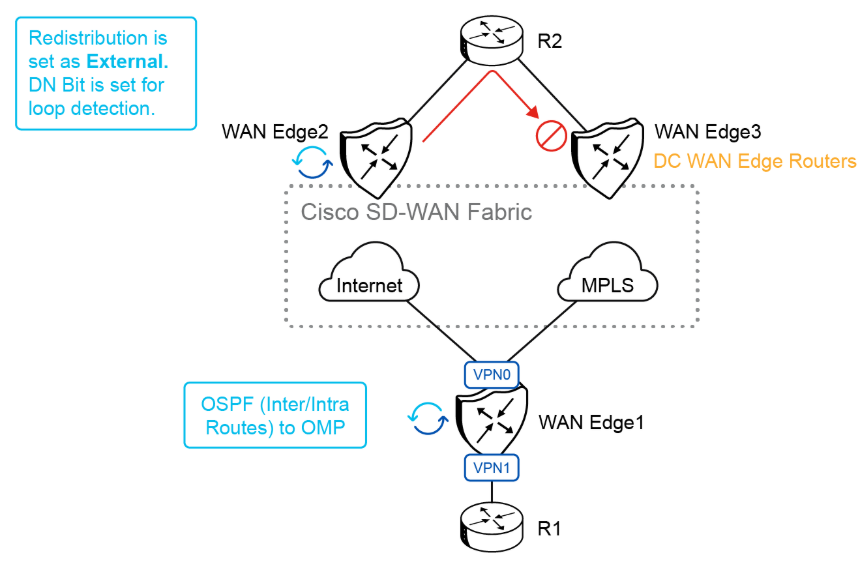
A previously unused bit in the OSPF LSA Options Field is referred to as the DN bit. This bit is set on LSAs when routes are redistributed into OSPF. When the other WAN Edge router receives the LSA with the DN bit set, the information from that LSA is not used in the OSPF route calculation. In the figure, WAN Edge3 rejects the external LSA advertised by WAN Edge2 because the DN bit is set, since the network was originally sourced from OMP.

Comment
TABLE OF CONTENTS
- Onboarding & Provisioning Configuring Templates
- Authentication between vSmart & vBond
- Authentication between vSmart Controller
- Authentication between vBond & vEdge Router
- Authentication between vEdge Router & vManage NMS
- Authentication between vSmart Controller & vEdge Router
- Viptela Specific Port Terminology
- Deploy & Configure vManage & Generate Certificate
- Deploy & Configure vBond & Generate Certificate
- Deploy & Configure vSmart & Generate Certificate
- Configure vEdge & Generate Certificate
- SDWAN & NAT
- Secure DataPlane Bringup
- Enterprise CA for SDWAN Instances
- ZTP Process & PnP Overview
- Control Plane & Data Plane Operation - Unicast Routing Overview
- Configuring OMP & Its attributes
- Configure Unicast Overlay Routing
- Routing Configuration Example
- Segmentation Overview
- Configuring Segmentation
- Segmentation Configuration Example
- Data Traffic across Private WANs
- NAT in SDWAN & Data Encryption
- SD-WAN Viptela Policy Overview
- SD-WAN Centralized & Localized Control Policy Overview
- SD-WAN Centralized & Localized Data Policy
- Service Chaining
- Traffic Flow Monitoring
- vEdge Router as NAT Device
- Zone Based Firewalls
- Configure Centralized Control Policy
- Configuring Centralized Data Policy
- Configuring Cflowd Traffic Monitoring
- Configuring Zone based Firewall
- Service Chaining Configuration Example
- Configuring Service Side NAT
- Configuring Transport side NAT
- Control Policy Example 1: Hierarchical Topology
- Multi-Region Fabric
- Control Policy Example 2: Implementing Traffic Engineering
- Control Policy Example 2: Dynamic On-Demand Tunnels
- LAB Deploy Cisco SD-WAN Edge Routers
- LAB Deploy SDWAN Controllers
- LAB Deploy Cisco SD-WAN Devices Using Configuration Group
- LAB Implement Service-Side Routing Protocols
- LAB Implement TLOC Extensions
- LAB Implement Control Policies
- LAB Implement Data Policies
- LAB Implement Application-Aware Routing
- LAB Implement Branch and Regional Internet Breakouts
- LAB Migrate Branch Sites
RECENT POSTS
- Understanding Cisco ISE Authentication and Authorization Policies
- Installing Context-Aware Network Access Control using Cisco ISE Policies
- Designing Network Access Control that is Scalable using Cisco ISE Architecture
- Enterprise Network Access Control and Policy Enforcement using Cisco ISE
- Secure Device Administration and Network Access Using AAA Architecture
- Designing Enterprise-Class Hybrid Cloud Connectivity Using AWS Networking Services
- Exploring Core AWS Networking and Messaging Concepts for Modern Cloud Architectures
- Understanding Key AWS Services for Modern Cloud Architectures
- Building a Strong AWS Foundation with Amazon S3, EC2, and Virtual Private Cloud
- Understanding the ENSDWI Course: Advanced Cisco SD-WAN (Viptela) Concepts


LEAVE A COMMENT
Please login here to comment.