
EMAIL SUPPORT
dclessons@dclessons.comLOCATION
USExploring Cisco ISE Authorization Policy Elements
Introduction
Controlling access to networks is among the primary tasks of the modern team members in security and information technology. While authentication validates the identity of the user as well as a device, authorization decides what resources a user device is able to access once authentication has been successful. Without an authorization framework that is well-designed, it can be difficult for organizations to ensure security policies are consistently enforced throughout their entire network.
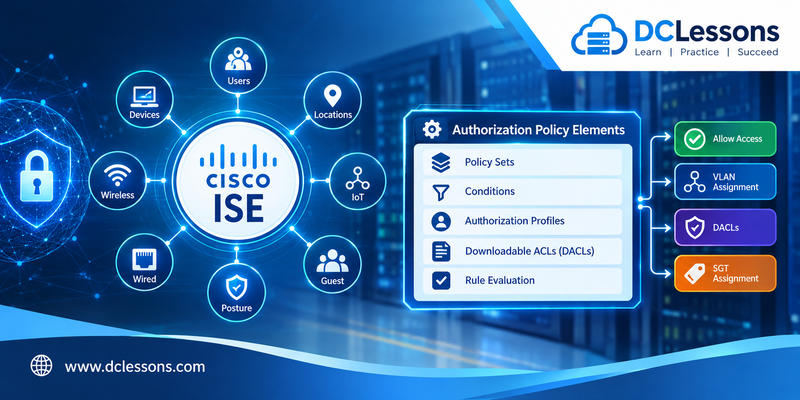
Cisco Identity Services Engine (ISE) is a robust authorization engine that allows administrators to establish access control policies that are based on identities across wireless, wired, guest, and VPN as well as IoT environments. By using authorization policies such as policy sets and conditions such as ACLs that can be downloaded, as well as authorization profiles, businesses can make smart access decisions according to user roles, devices, types of devices, locations, security posture, and other characteristics.
In this blog we'll look at Cisco ISE Authorization Policy Elements learn about the structure of authorization policies and the ways authorization profiles and download ACLs can help security for network access.
What Are Authorization Policies in Cisco ISE?
Policies for authorization in Cisco ISE define the degree that access is granted devices and users following successful authentication.
If a device or user is connected to a network Cisco ISE first verifies authenticity using the authentication policies. After authentication is successful the authorization policies assess various circumstances and determine the appropriate access rights.
Authorization decisions can include:
Full network access
assigning users to certain VLANs
Applying Downloadable ACLs (DACLs)
Assigning Security Group Tags (SGTs)
Access to restricted resources
Access for guests only
Authorization policies help organizations implement access control that is business-driven, while ensuring centralized policy management.
Understanding Cisco ISE Policy Sets
Policy Sets serve as the basis which organizes authorization and authentication policies within Cisco ISE.
A policy set combines authorization and authentication rules designed to meet a particular use case. Instead of storing a large set of policy sets, managers are able to create separate policies for various network environments.
Common Policy Set examples include:
Wired user access
Access to the wireless user
Access for guests
BYOD environments
TrustSec deployments
Administration of devices (TACACS+)
Policy Sets help simplify management of policies and increase scalability for huge enterprise networks.
How Policy Sets Organize Authentication and Authorization
If a request for network access is received, Cisco ISE evaluates Policy Sets from the top to the bottom.
The procedure is based on these steps:
Cisco ISE identifies the matching Policy Set.
The policies for authentication validate the identities.
Authorization policies determine access permissions.
The authorization results are delivered by the router device.
This structured workflow ensures uniformity across all possible network access scenarios.
Cisco ISE Authorization Policy Types
Cisco ISE supports three primary types of authorization policies.
Exception Policies
The exception policies are analyzed prior to any other authorization policies.
If an Policy is found to be an exception, if the Policy is found to match, Cisco ISE immediately applies the result of authorization and stops processing any additional policies.
Exception Policy are often used to:
Access requirements for temporary access
Emergency policy can be overridden
Testing scenarios
Specific business needs
Because of their high importance, Exception Policy should be carefully used.
Standard Policies
Standard policies are the most frequently utilized authorization policies.
These policies are designed to handle daily network access and are accountable for the enforcement of the majority of organizations' security requirements for access control.
Examples include:
Access policies for employees
Policies on access for contractors
Guest access rules
Access policies specific to devices
Default Policies
Every authorization policy set has the default policy.
If there is no exception policy or standard policy met, Cisco ISE applies the default policy.
A default policy typically:
Denies access
Access to limited grants
Redirects users to the corrective action
Standard policies make sure that each access request is subject to an approval decision.
Understanding ISE Policy Elements
Authorization policies are created with policy elements.
Each authorization rule usually contains:
Rule Status
Rule Name
Identity Groups
Conditions
Permissions
Cisco ISE organizes policy elements into three main categories.
Dictionaries
Dictionaries are the collections of characteristics that are used in Cisco ISE.
These characteristics may come from:
RADIUS requests
Active Directory queries
Syslog messages
SNMP traps
Endpoint profiler data
Cisco ISE includes hundreds of predefined system dictionaries to aid administrators in creating advanced policies.
Conditions
The conditions define criteria to assess access requests.
The decision to authorize is based on the degree to which certain conditions are in line with the characteristics of the incoming request.
Results
The results define the permissions Cisco ISE applies when a rule is in accordance with.
Authorization results usually comprise the following:
Authorization Profiles
Downloadable ACLs
These elements decide the last access privileges granted to the device or user.
ISE Policy Rule Conditions
Conditions are among the most crucial elements in Cisco ISE authorization policies.
They define the process that is used to assess the network's access request.
Cisco ISE supports two primary condition types.
Simple Conditions
A simple condition is composed of:
A characteristic
An operator
A valuable value
For instance:
Device Type = Switch
This condition examines one attribute and determines if it is in line with the value specified.
Simple Condition can be saved to allow use across different authorization policies.
Compound Conditions
Compound Conditions mix multiple Simple Conditions by using logic operators like AND and OR.
For instance:
(Device Type = Switch) AND (AD Group = Employee)
The condition demands both of the criteria to be met before the rule is matched.
Compound conditions offer greater flexibility and permit administrators to design more precise authorization policies.
Understanding Authorization Results in Cisco ISE
Authorization results determine what rights are granted in the event that an authorization policy is compatible.
These are the results that are vital to control device and user access to the network.
Authorization results generally are divided into two categories:
Downloadable ACLs (DACLs)
Authorization Profiles
Downloadable ACLs (DACLs)
Downloadable ACLs are among the most powerful features for authorization included in Cisco ISE.
As opposed to manually setting ACLs for the individual device networks, network administrators are able to centrally configure ACLs in Cisco ISE and dynamically download them to wireless controllers and other devices that are supported.
A DACL can comprise:
IP addresses from the source
IP addresses of the destination
Protocol types
Ports for source and destination
Permit statements
Deny statements.
For instance, an employee could get access to internal apps, whereas guests have access to the internet exclusively.
DACLs enhance scalability and make it easier to manage policy management since modifications are managed centrally inside Cisco ISE rather than on each network device.
How Cisco ISE Authorization Profiles Work
Authorization profiles are collections of permissions that define the way network access is managed.
If an authorization policy is compatible, Cisco ISE applies the associated authorization profile.
Authorization profiles may contain:
Access Accept
Access Reject
VLAN assignment
Downloadable ACL references to the ACL
Session timeouts
Timers for authentication
Security authorizations
Because authorization profiles can be reused, administrators can use them to create standard access policies across different authorization rules.
Common Authorization Profile Attributes
The most commonly configured attributes include
VLAN Assignment
Users are able to be assigned to various VLANs according to their position or department.
Access Accept and Access Reject
Cisco ISE can either permit or deny access to networks according to the policy requirements.
Session Timers
Reauthentication and session timers can improve security and ensure compliance.
Security Permissions
Authorization profiles are able to provide additional security measures through ACLs as well as policy attributes.
This makes authorization profiles a crucial element for Cisco ISE network access control.
First Matched Rule vs. Multiple Matched Rule in Cisco ISE
Cisco ISE supports two authorization methods of policy execution.
First Matched Rule
This is the default behaviour.
Cisco ISE evaluates authorization policies from the top to the bottom.
Once a suitable rule is discovered:
The permissions associated with them are then in effect.
Policy evaluation ceases.
This is similar to the traditional firewalls that process ACLs.
Multiple Matched Rule
If Multiple Matched Rule mode is activated:
Cisco ISE evaluates all authorization rules.
All permissions that match are merged.
A consolidated authorization result is produced.
This option offers more flexibility to organizations with more complex access control needs.
Administrators must carefully consider the model that best fits the security guidelines of their organization.
Best Practices for Cisco ISE Authorization Policy Design
A well-designed policy can improve security, scalability, and efficiency of operations.
Organize Policies by Use Case
Create separate policy sets to:
Access via wired
Access to wireless
Access for guests
IoT devices
VPN users
Use Reusable Conditions
Utilizable conditions make administration simpler and decrease policy complexity.
Standardize Authorization Profiles
The reuse of profiles makes managing policy simpler and increases the consistency.
Keep Rule Order Organized
Since policies are analyzed sequentially and based on the order in which they are evaluated, the correct rule placement is crucial.
Review Policies Regularly
The requirements for business change with time. Regular reviews can help ensure the policies for authorization are in place and in compliance.
Common Authorization Policy Issues and Troubleshooting
Even well-designed deployments may encounter authorization challenges.
Common Issues
Incorrect policy order
Missing Authorization Profiles
Unconfigured conditions
Incorrect DACL assignments
Identity group mismatches
Issues with Selecting a Policy Set
Troubleshooting Recommendations
Review authorization logs within Cisco ISE.
Verify the condition matches.
Confirm the Authorization Profile assignments.
Verify DACL configurations.
Test authorization policies before deployment.
Active monitoring can dramatically cut the time needed to solve problems.
Conclusion
Cisco ISE Authorization Policy Elements provide the basis for security of access to networks based on identities. By combining policy sets, conditions, and authorization profiles with ACLs that are downloadable, organizations can design flexible and adaptable authorization policies that are in line with the security and business needs.
When it comes to managing access of employees or guest connectivity to IoT devices as well as contractor networks Cisco ISE provides the devices needed to make the authorization decisions and ensure they are enforced uniformly across the entire enterprise.
For professionals in the field of networking seeking experience on the Cisco ISE platform, Dclessons offers comprehensive Cisco ISE instruction, hands-on labs, and real-world scenarios for implementation to help students understand the policy and authorization rules, as well as authorization profiles and DACLs, along with advanced control of access concepts.
Frequently Asked Questions (FAQs)
What's an authorization rule for Cisco the ISE?
An authorization policy defines what resources are available, what services, and what permissions the authenticated device or user will be able to access following successful authentication.
What are policy sets in Cisco ISE?
Policy sets are a collection of authorization and authentication rules that are arranged around specific uses, like wired access guests accessing via wireless or device management.
What's the distinction between the Authorization Profile and the ADL?
The authorization profile is a set of access rights and RADIUS attributes. The DACL is a downloadable access control list that controls the flow of traffic through any network devices.
What's the point of exception policies within Cisco ISE?
These policies are given the most importance and are reviewed prior to standard authorization policies. They are typically used to provide temporary exceptions or for special access conditions.
What are compound conditions in Cisco ISE?
Compound conditions are a combination of multiple simple conditions by using logic operators like OR or AND, which allows administrators to develop more precise authorization policies.
You might also find these blog posts interesting:
Understanding Cisco ISE Authentication and Authorization Policies
Installing Context-Aware Network Access Control using Cisco ISE Policies
Designing Network Access Control that is Scalable Using Cisco ISE Architecture
Comment
RECENT POSTS
- Exploring Cisco ISE Authorization Policy Elements
- Understanding Cisco ISE Authentication and Authorization Policies
- Installing Context-Aware Network Access Control using Cisco ISE Policies
- Designing Network Access Control that is Scalable using Cisco ISE Architecture
- Enterprise Network Access Control and Policy Enforcement using Cisco ISE
- Secure Device Administration and Network Access Using AAA Architecture
- Designing Enterprise-Class Hybrid Cloud Connectivity Using AWS Networking Services
- Exploring Core AWS Networking and Messaging Concepts for Modern Cloud Architectures
- Understanding Key AWS Services for Modern Cloud Architectures
- Building a Strong AWS Foundation with Amazon S3, EC2, and Virtual Private Cloud


LEAVE A COMMENT
Please login here to comment.